
Water is Life and Clean Water Means Health – Audrey Hepburn
Access to safe water is a big problem in Nigeria. This is due to the high levels of poverty associated with rural areas and the increasing urbanization and population associated with urban areas in the country. In Nigeria, more than half of the entire population does not have access to safe water making it highly unlikely for the country to achieve the UN’s sustainable development goals set for 2030 regarding the provision of quality water. The situation is worst in Lagos state, the so-called economic heart of Nigeria. I have spent more than 3 decades on Earth with 2 decades and a half in my home country (mostly in Lagos) and this problem has been there for as long as I can remember. I will start by talking about my experience as a little girl growing up in an area in Lagos with a lack of safe water.
Lagos state is divided into two areas, the mainland where the middle and low-income populations live, and the island where the high-income populations live. This housing inequality is also reflected in the distribution of safe water across the state simply because high-income households have access to safe water (either through treated pipes or through treated boreholes) while middle and low-income households depend majorly on untreated boreholes, dug wells, and water vendors. Some middle-income households on the mainland have boreholes that are not in many cases free from contaminants and dug wells are not treated at all. Fecal contaminants, pesticides, herbicides, heavy metals, and pharmaceutical compounds are therefore widespread in boreholes and dug wells that people depend on for daily use apart from drinking. Low- and middle-income households mostly buy packaged sachet water for drinking purposes.
As a girl from a very low-income family, I remember having to go several miles to fetch water with a big bucket on my head just like in the diagram below, but my bucket is in most cases bigger than that. There are different water vendors in Lagos. These vendors are people who sell packaged sachet water (mostly for drinking) and those who sell water directly from their self-made boreholes. Low-income households buy water from the latter for daily use, but you must go to the vendor to fetch the water and pay for the water you are fetching. If you are lucky, you can have this vendor in your street, if not, you must walk some miles to fetch the water with a bucket on your head.
As a little girl, I will not go only once to fetch water every day, but I will sometimes go five to six times depending on the family’s needs. The water vendor was also not close to our house, and I can tell you how difficult and painful it is to carry a large bucket of water on your head for several minutes until you get home, empty the bucket, and then go for another round. I did this throughout my childhood age even until I became a teenager. It only stopped when I got to the University, not because safe water was accessible but because I could afford to pay water vendors to supply me with water.
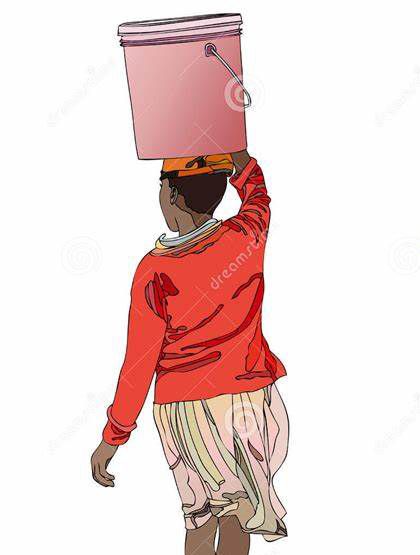
Sadly, the situation of safe water inaccessibility is worst now, and many girls (from low-income households) are subjected to this hardship as more than 90 % of households do not have access to treated piped water and they must fend for themselves with girls bearing the burden in most cases. Access to safe water is a fundamental human right but the question is, why don’t we have access to safe water in Lagos, or should I say, why is there a large inequality in access to safe water in Lagos?
The Lagos Water Corporation oversees safe water supply in Lagos state. The organization’s mission is to ensure safe water provisions for all Lagos residents regardless of their socio-economic status. Reading the website of the organization, I see that the current water production capacity is 210 million gallons per day. According to them, this capacity exceeds the current water demand in Lagos which is true. Currently, there are 16 million populations in Lagos state, and each population only requires 50 liters (~ 11 gallons) of safe water per day. So, what happens? Why is it that 90 % of people still fend for their daily water use? The water sector also developed a roadmap through which their production capacity would increase to 745 million gallons per day in 2020 but this apparently has not addressed the water shortage experienced by the population.
Several factors are hampering the distribution of safe water to Lagos households. According to Jideonwo (2014), these factors include poor implementation of water production strategies, unstable power supply, low revenue generation, inadequate funding, and lacking water governance. In addition, there is no regulation restricting the discharge of pollutants in the state leading to a widespread of water pollution. Lagos Water Corporation also complained of the destruction of water pipes, vandalization, and theft of water equipment.
Access to safe water is a fundamental human right and lack of safe water is a health problem that needs to be addressed as soon as possible as people now depend on water sources polluted with anthropogenic pollutants such as heavy metals, microplastics, arsenic, antibiotics, and other pharmaceutical care products. Without good-quality water, maintaining good sanitation and hygiene is almost impossible leading to microbial contamination of the water system which culminates in the spread of waterborne disease in several communities. There are ways through which the Lagos state government can improve safe water supply to Lagos households. These include:
- Investing more in better infrastructure such as water treatment plants, water storage facilities, and pipelines can improve the production, treatment, and distribution of safe water.
- Regular monitoring of water quality can help identify and address issues before they become widespread, thereby reducing the occurrence of waterborne diseases.
- Educating the public on proper sanitation and hygiene can significantly reduce water contamination. Simple practices such as handwashing can help prevent the spread of waterborne diseases.
- The Lagos State government can collaborate with the private sector on water production ventures, tapping into private sector innovations and funding to deliver water to the residents.
- Encouraging households and institutions to harvest rainwater can reduce dependency on public water sources and prove as a complementary source of water supply to the people of Lagos State.
- Supply water to households and encourage them to pay a little amount of money. These can help in revenue generation which can be used to strengthen water infrastructures.
I will drop my pen here, I hope you enjoy the article, please feel free to drop your recommendation on how safe water provision can be improved not only in Lagos state but also in your Location.
 Everything Health and Education