
Impacts of human activities on the environment
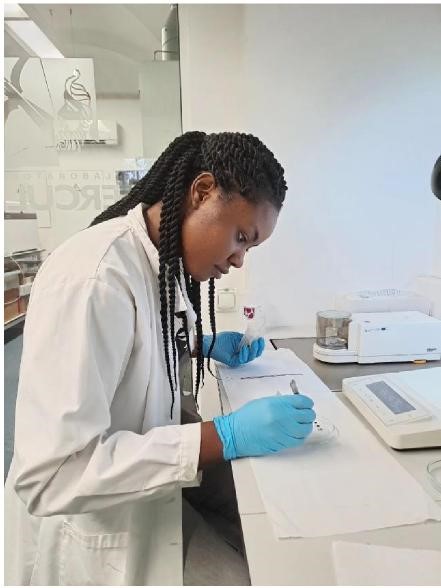
I am Amarachi Amazu, a final-year Erasmus Mundus master’s student in Archaeological Material Science (ARCHMAT). The ARCHMAT program is a joint master’s initiative between three consortium universities: the University of Évora in Portugal, Aristotle University of Thessaloniki in Greece, and Sapienza University of Rome in Italy.
I am working on my final thesis, which involves analyzing sediments from Oued Ksar Seghir, Morocco, to establish the region’s environmental context. This research is being conducted at the Archaeosciences Laboratory of the Portuguese Cultural Heritage Institute in collaboration with the Instituto Dom Luiz (IDL) at the University of \Lisbon and the Hercules Laboratory at the University of Évora. I am incredibly passionate about unraveling the mysteries of past environments by analyzing ancient materials. My research involves delving into the intricate relationship between sedimentary deposits, organic compounds, and the environmental contexts in which they formed. It’s a fascinating journey that allows me to combine knowledge from various scientific disciplines to piece together the puzzle of our planet’s history.
About my current research
Humans constantly interact with their environment through various activities, leading to significant changes shaping our world. Today, climate change driven by global warming affects every aspect of our lives, from ecosystems to economies. While numerous policies and initiatives aim to mitigate the adverse effects of climate change, the issue ultimately stems from how we interact with our environment daily. Seemingly minor activities such as deforestation, bush burning, mining, population growth, waste generation, etc., collectively severely impact the environment. Understanding how these activities continuously shape our surroundings is essential for making informed environmental decisions and addressing the challenges posed by climate change.
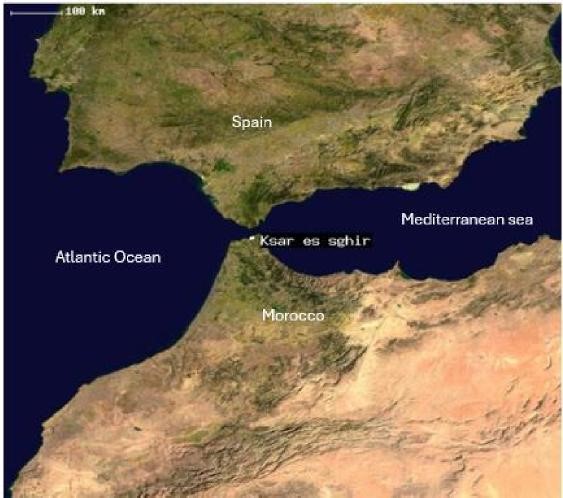
My current research focuses on characterizing the environment of Oued Ksar Seghir to understand how it has evolved over time and to relate these changes to human activities in the region. Oued Ksar Seghir is a river located in Ksar Seghir, a town on the northern Moroccan coast (see Fig. 1). Due to the strategic position of this region, there were significant coastal and maritime activities in the 15th and 16th centuries which drastically altered the morphology of the surrounding environment, making it more susceptible to erosion and accretion [1]. To assess the extent of these changes, my research involves analyzing a 4.9-meter sediment core collected near the river. This core is studied with various environmental proxies, including sedimentology and organic geochemistry, and will be radiocarbon-dated to establish an age model that can be correlated with observed environmental changes
This research will contribute to paleoclimate studies and provide better insights into the long-term impacts of human activities on the environment. Ultimately, it aims to enhance our understanding of historical environmental transformations, supporting more informed decision-making and more accurate predictions regarding climate change.
Reference
Cheddadi, R., Nourelbait, M., Bouaissa, O., Tabel, J., Rhoujjati, A., López. Sáez, J.A., AlbaSánchez, F., Khater, C., Ballouche, A., Dezileau, L., Lamb, H. A history of human impact on Moroccan mountain landscapes. African Archaeological Review (2015) 32(2), 233–248 DOI:10.1007/s10437-015-9186-7
 Everything Health and Education